
Wondering why get a master’s in nursing? This degree type can help advance your career. Learn how graduate nursing education can support advanced knowledge, leadership development and career growth, and explore how Marquette DE-MSN prepares career changers to pursue RN licensure.
Nursing offers more than one path into practice and more than one way to grow. A master's degree can help nurses build broader knowledge, create a foundation for specialized education and prepare for leadership. Direct-entry programs can also give career changers a route into nursing at the graduate level.
An MSN does not guarantee an advanced practice role or promotion, but it can help you bring a higher level of academic preparation to nursing and position you for future opportunities. Marquette University’s Second Degree Direct Entry Master of Science in Nursing (DE-MSN) program allows students with a non-nursing bachelor’s degree to study nursing and graduate on an accelerated timeframe, ready to enter the nursing field as an excellent practicing registered nurse (RN).
Explore the benefits of a master’s degree in nursing, see how it compares to a BSN degree and examine where an MSN degree can take you.
What Is a Master's in Nursing?
A Master of Science in Nursing (MSN) is a graduate degree that provides a more comprehensive education than a bachelor’s-level nursing degree. Traditional MSN programs may commonly serve licensed nurses who already hold a Bachelor of Science in Nursing (BSN). RN-to-MSN programs may serve eligible registered nurses with an associate degree or diploma. Direct-entry MSN programs like ours deliver a curriculum that prepares students with a non-nursing bachelor's degree to enter the field.
Do You Need a Master's Degree to Be a Nurse?
No, you do not need a master’s degree to become a nurse. Registered nurses may enter the profession after completing an accredited nursing program, meeting state requirements and passing the NCLEX-RN to receive RN licensure.
Earning a Bachelor of Science in Nursing (BSN) degree or higher, however, is becoming increasingly common. Results from the 2024 National Nursing Workforce Survey show that the percentage of RNs with a BSN or higher degree in the US workforce is 72.9%. Nurses who have earned an MSN or higher degree represent 25.1% of the workforce.
See why you should consider pursuing your MSN degree through a Direct Entry MSN program.

Why Get a Master's in Nursing?
The value of an MSN is not limited to the credential. Graduate nursing education can change how a nurse evaluates evidence, leads improvement and understands care across an organization.
Expand Your Career Opportunities
As also reported in the 2024 National Nursing Workforce Survey, 51.5% of newly licensed nurses now enter the workforce with a BSN or entry-level master’s degree. Bachelor’s degrees represent 46% of that figure, making MSN-prepared candidates stand out among newly licensed RNs. Between 2015 and 2024, the proportion of RNs who first entered the field with an MSN degree increased from 2.8% to 5.5%, indicating that this is a growing trend.
Nursing careers extend beyond one setting or patient population. Depending on the employer and the additional education and experience they have gained, MSN-prepared nurses may pursue work in areas such as:
- Administration
- Advanced practice
- Consulting
- Informatics
- Policy
- Research
These options are not automatic outcomes of graduation. Some positions require further education, RN experience or specialty certification. Still, an MSN degree can make it easier to build a career plan with more possibilities.
Prepare for Leadership Roles
Nurses lead when they coordinate care, improve processes and support colleagues, and a leadership role requires talent and drive.
Preparing for your career by earning an MSN can help you gain roles such as assistant nurse manager, director of nursing or nurse manager after you gain additional experience, degrees or certifications.
Build Advanced Clinical Knowledge
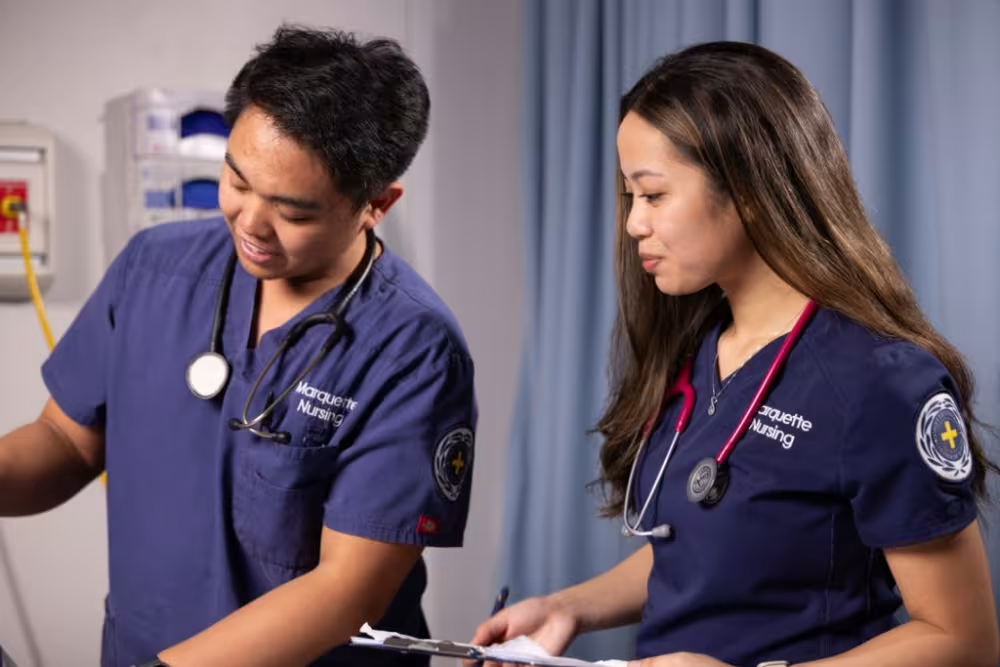
MSN coursework deepens a nurse's understanding of evidence-based practice and core nursing concepts. Marquette DE-MSN students complete predominantly online or predominantly in-person coursework, depending on their enrollment location. At our program site in Pleasant Prairie, Wisconsin, or at our main Milwaukee campus, you will learn the foundational nursing knowledge required for RN practice.
Students build on the concepts they study through in-person nursing labs, developing nursing knowledge and applying it in supervised settings. Clinical rotations at top area health care facilities gives students a chance to explore different practice areas, though experience in any one practice area is never guaranteed.
Prepare for Advanced Practice Nursing
Advanced clinical knowledge does not make a DE-MSN graduate who attains RN licensure an advanced practice nurse. Nurse anesthetists, nurse midwives and nurse practitioners complete role-specific and population-specific postgraduate education before meeting additional licensure requirements.
The outlook for advanced practice nursing also helps explain the interest in these careers. The U.S. Bureau of Labor Statistics projects 36% employment growth from 2025 to 2035 for the advanced practice roles of nurse anesthetists, nurse midwives and nurse practitioners. This projection does not guarantee employment, but it shows sustained demand for these professionals.
Support Long-Term Career Growth
Nursing constantly changes as evidence, patient needs and technology evolve. An MSN can help nurses build learning habits to assess and apply information more confidently. That habit supports career growth even when a nurse's goals change.
Graduate preparation may support doctoral education, project leadership or specialty practice. It can also provide useful context for career conversations with employers and mentors. The best long-term benefit is flexibility: a nurse can build experience first and make informed decisions about their next credential or role.

See the nursing leadership roles that a MSN degree can help prepare you for.
Master's in Nursing vs. Bachelor's: What's the Difference?
The master’s in nursing vs bachelor’s in nursing comparison begins with the purpose of each degree. A Bachelor of Science in Nursing provides broad preparation for RN practice. BSN curricula generally include clinical care, community health, leadership and research. Graduates of approved prelicensure programs can apply for RN licensure and take the NCLEX-RN.
An MSN is a graduate degree. Traditional MSN programs build on prior nursing education and may focus on advanced practice, education or leadership. A Direct Entry MSN combines prelicensure nursing preparation with graduate-level coursework for students who already hold a bachelor's degree in another field.
Degree level alone does not determine scope of practice. A BSN-prepared RN and a generalist MSN-prepared RN practice within the RN scope authorized by their state. When comparing programs, consider factors such as:
- Career goals
- Cost
- Format
- Graduate outcomes
- Time to completion
Is a Master's in Nursing Worth It?
If your question is whether a master’s in nursing is worth it, start with the outcome you want. An MSN may be worthwhile if the degree matches your career plan and provides a reasonable path from your current education to nursing practice or advancement.
For career changers, a Direct Entry MSN like Marquette’s may offer a way to build on a previous bachelor's degree while preparing for RN licensure. In either case, compare career goals, cost, program support and time demands. It is also useful to review accreditation, completion data and licensure outcomes.
The financial return will vary by employer, location, responsibility and specialty. The BLS reports a $97,550 median annual wage for registered nurses as of May 2025, across multiple degree types and roles. An MSN should be viewed as an investment in flexibility and preparation rather than a guarantee of higher pay.
Start Your Nursing Journey at Marquette University's Direct Entry MSN Program
Marquette University's DE-MSN curriculum is designed to help students develop the clinical judgment and professional perspective needed for entry-level nursing.
If our program fits your background and goals, request information and connect with an admissions adviser today.